
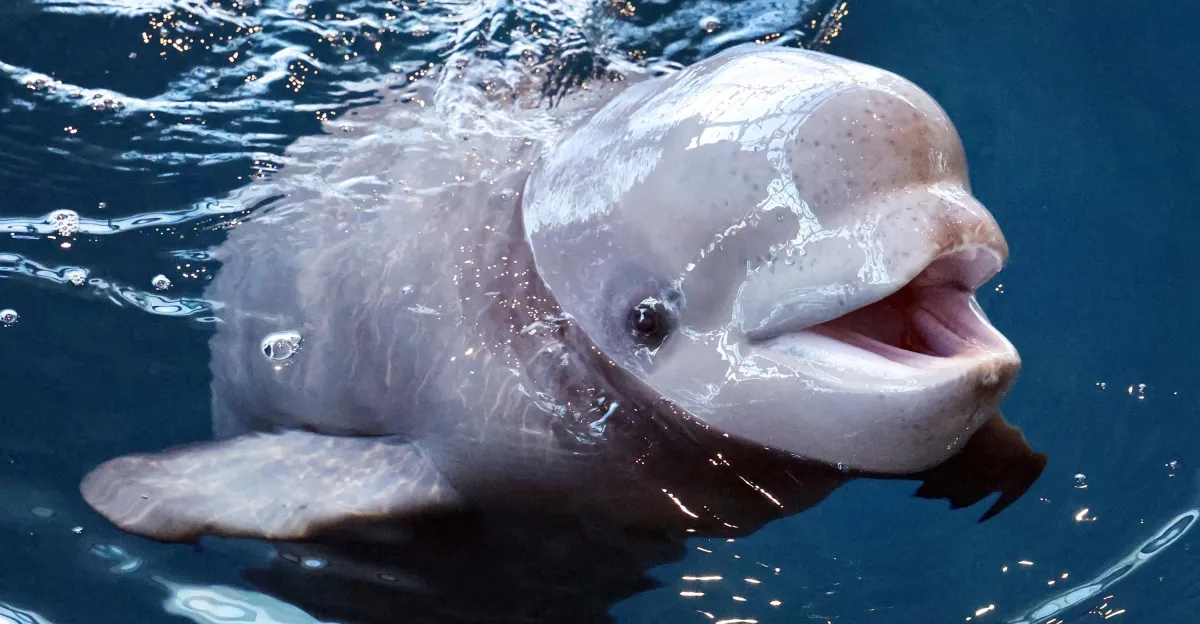
Two years ago, Marineland of Canada — a theme park in Niagara Falls that trained beluga whales, dolphins, and other animals to perform acrobatic tricks for entertainment — closed its doors. The decision came after years of financial turmoil, along with journalistic investigations, whistleblower accounts, and government inspections that revealed animal neglect and suffering at the park. Since 2019, 19 beluga whales and one killer whale have died at Marineland.
The closure was a win for animal welfare, but where would its animals go? Marineland’s surviving menagerie included, among other species, four dolphins and 30 beluga whales.
Given that beluga whales and dolphins are highly social animals that live in pods and swim long distances in the wild, animal welfare groups didn’t want to see them transferred to other parks like Marineland, or conventional aquariums, where the exceptionally smart and active animals would continue to suffer in captivity. Instead, they called for some of the 30 belugas to be rehomed to a proposed — though not yet built — 110-acre coastal sanctuary in Nova Scotia, Canada.
That didn’t happen. Instead, this summer, the four dolphins and two of the beluga whales went to an aquarium in Spain, while the other belugas were transferred to two SeaWorld locations — theme parks that are similar to Marineland — and two famous US aquariums: Georgia Aquarium in Atlanta, which received two, and Shedd Aquarium in Chicago, which received 10.
And just as Shedd’s belugas should’ve been adjusting to their new environment, things took a turn for the worse. Over the course of eight days from late August to early September, Peekachu and Rain — two belugas who arrived at Shedd Aquarium in mid-August — and another beluga whale named Beethoven, who had been at Shedd for decades, died.
The three animals’ cause of death at Shedd Aquarium remains unknown as the aquarium awaits necropsy results.
While the three deaths in quick succession have put a spotlight on Shedd, they have also renewed scrutiny of a deeper problem with aquariums: their intensive confinement of wild animals, which runs throughout their history and goes beyond any one institution or animal.
The limitations of aquarium life
Shedd Aquarium is one of the US’s oldest and most prestigious aquariums, though this isn’t its first beluga whale controversy.
Its first two belugas were taken from the wild — an estuary in Canada — in 1991. The next year, they got four more from the wild and soon after, two of them died from cardiovascular collapse after receiving an anti-parasitic drug.
“These whales died to serve a tourist attraction,” a spokesperson for the International Wildlife Coalition said at the time. “It’s horrific.”
Since then, Shedd hasn’t directly sourced any beluga whales from the wild, though it’s recorded 15 beluga births in captivity. But whether taken from the wild or born in captivity, some scientists and animal advocates argue the inherent limitations of aquarium life are inhumane. One of the most outspoken among them is neuroscientist Lori Marino, an expert in marine mammal behavior and intelligence and president of the Whale Sanctuary Project, which is building the proposed Nova Scotia sanctuary.
In the wild, beluga whales have far-ranging seasonal migrations, live in complex social groups, hunt for food, and raise juveniles. But Marino says that captive belugas — whether at a park like Marineland or a storied aquarium like Shedd — are in small, artificial, and unchanging environments that deny them the ability to engage in many of their natural behaviors.
“The level of boredom that they experience is really unbelievable,” Marino told Vox. “For an animal like that, with a brain like that, that’s torture.”
A Shedd spokesperson told me that research it participated in — along with other zoological institutions — found that ensuring that animal enclosures are dynamic, well managed, contain enrichment activities, and facilitate strong socialization do more to predict good welfare than the volume of space they’re allotted.
However, such artificial environments can lead to serious welfare problems. It’s not uncommon for marine mammals — and other animals in zoos and aquariums — to display “stereotypic” behavior, or repetitive motions that are indicators of stress. They might endlessly swim in circles or other patterns, continually regurgitate and reingest food, repetitively move their heads, or grate their teeth on hard surfaces. Critics call it “zoochosis.” Some researchers believe captivity may induce depressive-like states in some animals.
Zoos and aquariums tend to downplay the harms of captivity and, instead, position themselves as stewards of the animals at their facilities and protectors of their counterparts in the wild. Some animal advocates, including Marino, often argue this is largely a facade to justify the continued captivity of the animals.
Read more The people who fear AI are wasting time fighting each other
Are aquariums for animals, or us?
Known as “the Fish House,” the first modern aquarium opened in 1853 at the London Zoo. At the time, zoos and aquariums were pitched to the public as pure entertainment — places for city dwellers to see exotic animals from far away lands up close.
But as the modern environmental and animal welfare movements matured in the middle of the 20th century, they began to question the practice of putting wild-caught animals on display in enclosures that amounted to a minuscule fraction of their range in nature. By the 1970s, in response to the criticisms, some aquariums and zoos began to pivot from marketing themselves as entertainment venues to being invested in the conservation of wildlife.
Zoos and aquariums posit that if we’re to protect wild animals in, well, the wild, it makes sense that helping the public gain an affinity for them in a not-so-wild setting is an important part of the equation. Chicago’s Shedd Aquarium, for example, describes its mission as “sparking compassion, curiosity and conservation for the aquatic animal world.”
Aquariums and zoos often say they achieve these goals by raising a lot of money for conservation projects, helping to reintroduce vulnerable species back into the wild, and inspiring visitors to get involved in conservation.
There is some merit to the first claim. In 2022, the 238 zoos and aquariums accredited by the Association of Zoos and Aquariums (AZA) — of which Shedd is a member — spent $252 million on projects to protect and preserve wildlife habitats. It’s a lot of money, though it amounts to about 5 percent of what AZA members had spent on operations and construction.
The evidence is even thinner on aquariums’ and zoos’ claims around helping to reintroduce endangered species back into the wild, as it’s an incredibly difficult and rare feat, and on motivating attendees to become conservation advocates.
Some surveys of zoo-goers have found that zoo attendance can modestly improve their conservation knowledge and behavior. But despite some 700 million annual visits, far fewer visitors volunteer or donate to protect animals in the wild.
Despite the heavy conservation messaging, animal advocates argue that entertainment is still the priority for most zoological institutions. According to the AZA, 80 percent of the animals in its member aquariums are taken from the wild, which seems to be in direct conflict with protecting animals in the wild. Shedd Aquarium declined an interview request for this story, and when I asked a spokesperson what percent of its 32,000 animals were taken from the wild, they wouldn’t say.
“Acquiring animals from the wild is not contrary to conservation goals as long as species are acquired in an ethical and sustainable manner,” an AZA spokesperson said over email. “These are thought-out and strategic actions with sustainability in mind.” However, AZA didn’t define how to ethically and sustainably take animals from the wild.
And Shedd — like many other aquariums — encourages guests to pay for “encounter” experiences with beluga whales and other wild, non-domesticated species, like penguins, sea lions, and otters, at up to $205 a pop. These often involve the guests having a few minutes to pet the animals and take photographs with them. (The National Oceanic and Atmospheric Administration has Shedd and other facilities from using the rehomed belugas in encounter programs.)
A Shedd spokesperson told me the criticism of these encounter programs as inhumane and unethical is “unfounded and indeed contradictory,” citing a study about dolphins that it participated in. The study, however, wasn’t designed to measure how encounter programs affect dolphin welfare, but rather looked at how dolphins use their habitat, with encounter programs as one variable among many. A on encounter programs found that most research on them lacked rigor and that “the justification for using [encounter programs] within zoos remains questionable.”
As for the belugas at Shedd, Marino told me she hopes that they survive, but says this moment should lead to more honest conversations about the ethics of aquariums.
Institutions like Shedd “are supposed to be the best,” Marino said. “But people need to understand that it’s the best of something that doesn’t work. … It’s not a question of who’s accredited, who’s not. It’s about keeping these animals in tanks for entertainment. That’s the proposition that has to be probed, that has to be questioned. And that’s the one thing they don’t want to do.”
Shedd, for its part, doesn’t seem ready to probe the proposition quite yet. A spokesperson told Vox that it hasn’t ruled out breeding the animals it received from Marineland, which could mean another generation of long-lived belugas in captivity.
Read more The Supreme Court has finally had it with Trump’s plan to steal the midterms
- Animal Welfare
- Future Perfect