
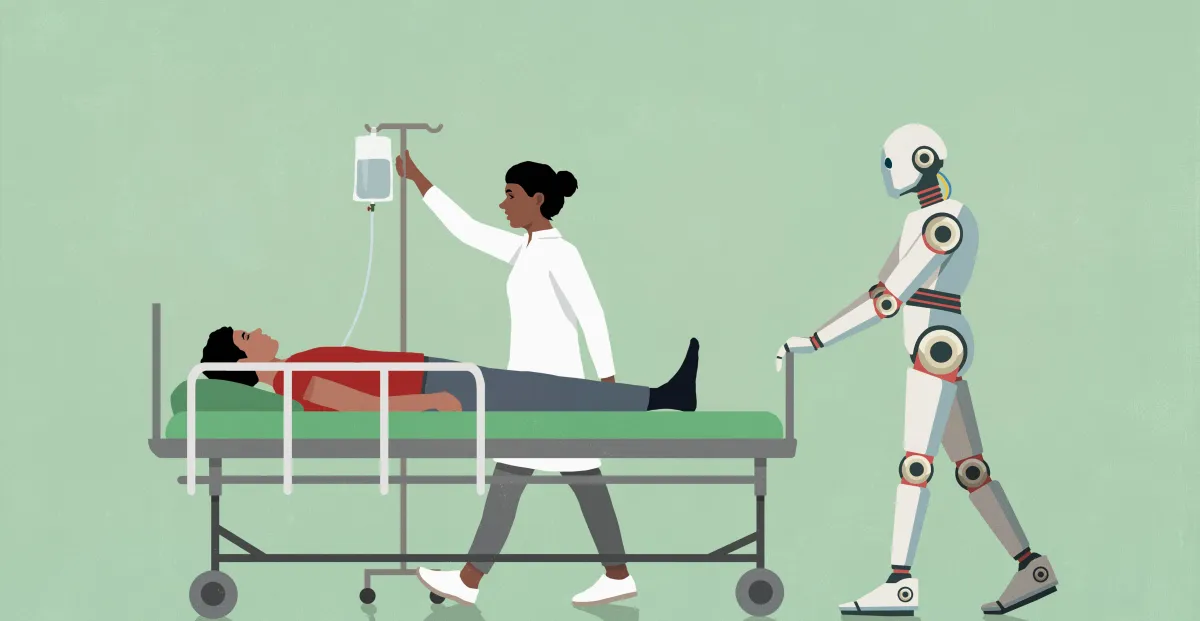
AI is the hottest thing in medical care right now — but many of us feel trepidation about it. Just one illustrative public survey sample: An October 2025 KFF poll found just 8 percent of Americans reported feeling a “great deal” of trust in AI managing their appointments or analyzing their health records, and only 32 percent said they would trust an online health tool that uses AI to access their medical records to provide personalized health information.
But many clinicians and healthcare administrators see AI as a powerful new tool that offers myriad opportunities to streamline and improve treatment. A 2026 survey found that more than 80 percent of US doctors use AI professionally — doubling the share from 2023. Physicians are excited by AI’s potential to keep more accurate notes of interactions with patients, to act as a second pair of eyes for human doctors, and to monitor people at risk of deteriorating and ending up in a dangerous situation.
The disconnect between what people and their providers want from AI could create more distrust, at a time when faith in the healthcare system and the medical profession have slid. Patients today want to feel empowered and in control. How can that be possible when these seemingly godlike machines are becoming more and more entrenched in our hospitals and doctors offices?
The answer comes in four words: “human in the loop.” It’s the principle upon which the ethical integration of AI depends and it could help to bridge the gap between lay people and the professionals on AI in medicine. In surveys, people are much more comfortable with the idea of their doctor using AI as an assistant than with AI acting on its own. And most clinicians want to use AI in that way, as a second opinion or passive monitor, not as a replacement for their judgment. There are real fears among the healthcare workforce about that possibility: A group of NYC nurses who were recently laid off claim it’s because their labor was going to be replaced by AI. “Human in the loop” appears to be a point of agreement between doctors and patients at this pivotal moment.
“Doctors…and nurses and staff always have been interested in primarily making the best decision for the people under their care — and these tools can help with that,” Alison Callahan, a research scientist at Stanford University who works on AI programs used in the university’s health system, told me. “The interest in making sure those tools are accurate is high.”
But what does “human in the loop” really mean in practice? How can you know when and how your doctor is using AI? And what is the best way to talk to your provider about the sudden influx of artificial intelligence in healthcare before a robot starts taking appointment notes or analyzing your MRI? I called some leading experts to find out.
How AI is currently being used in medicine
Patients and providers alike are incorporating AI into healthcare. Individuals are using commercial AI chatbots to ask about their symptoms or the health metrics tracked by their Apple Watch, while large academic medical centers are developing sophisticated programs and protocols to try to improve medical care at the population level.
It starts with ChatGPT, Claude, etc. — the large language models that are available to the public. People are increasingly turning to them to try to understand what’s going on with their own bodies. Individual physicians are also consulting with large language models to answer questions or get up-to-date on the latest research as they figure out how to best care for their patients.
Then there are ways in which hospitals and doctors offices are adopting AI at the institutional level. Many facilities are using AI as a way to take, collate, and summarize notes on a patient; in theory, it’s a more organized way to keep track of the informal interactions and observations that doctors have when checking on their own patients. Hospitals are also using AI to handle some administrative tasks, like scheduling follow-up appointments; some health systems have even started to use AI to help patients get ready for appointments — to send reminders about colonoscopy prep, for example.
And finally, you have maybe the most ambitious use of AI by health systems right now: as a diagnostic and risk prediction tool. In these cases, AI might offer a second opinion when, for example, a doctor is triaging a patient in the emergency room. It might help the ER staff figure out how to prioritize patients. Or these programs could monitor people either during a hospital stay or out in the real world (by drawing data from the person’s wearable) and make predictions about who may be at higher risk of complications and require further care. AI could recommend that somebody would benefit from seeing certain specialists or receiving a specific medicine or lab test, and generally offer proactive advice about the patient’s medical care.
But at this point, AI adoption is still “highly localized,” said Jennifer Goldsack, CEO of the Digital Medicine Society, a nonprofit that works with healthcare providers, drug makers, and government agencies on how to incorporate new tech (including AI) into clinical care. It depends on the individual doctor or health system. A lot of them are setting up their own programs and their own protocols for how to use these tools.
That is a big reason why it is so important for patients to be proactive about understanding how AI is being used for their health care. You can’t make assumptions; the only way you’re going to know for sure is to ask.
The questions you should ask your doctor about AI
By and large, experts say, patients should feel confident: Doctors and nurses want to keep a human in the loop, even as they integrate AI into their workflows.
Read more The iPhone lease is too good to be true
“It will be a doctor who is going to be reading that summary or a nurse who is going to be reading that summary and then taking an action to order a lab or put a recommendation in for a follow-up appointment,” Callahan said. “There is high interest in making sure that that is the right decision for that person. That hasn’t changed.”
Still, many patients say they’d be more comfortable with AI use if their doctor fully explained it in advance. And health systems may have their own priorities that push their facilities toward more rapid AI adoption and delegating more tasks to these AI tools, as seen in the recent NYC nurse layoffs.
So if you want to be informed on exactly where this technology is present and have the ability to consent to its use, you have every right to ask your doctor, experts say.
“AI is new, but the trust that serves as the foundation of the physician-patient relationship is not,” Timothy Keyes, a machine learning scientist at Stanford Health Care, told me over email. “To that end, I think that conversations about medical AI use should be open, honest, and transparent — just like any other conversations about shared decision-making in the clinical environment should be.”
For some things, your doctor should be asking you proactively if you consent to AI use — note-taking, for example. At my most recent primary care appointment, my doctor asked me if it’d be okay for him to use AI to take and summarize notes from our conversation; Goldstack told me she’d experienced the same at recent physician visits. (This is probably the most common AI use that you will encounter, and Keyes said it’s worth considering giving your consent: “There is growing evidence that they reduce physician burnout and save them at least a bit of time each day writing notes.”)
There are also a number of direct questions that you can ask:
And the transparency goes both ways. If you’re asking a question because you consulted ChatGPT before your appointment, tell your doctor. If you’ve talked with a chatbot because of mental health struggles, tell your doctor. And at the same time, feel free to ask your physician how you yourself could actually use AI in a responsible and productive way to improve your health.
“This opens up the opportunity for both the physician and the patient to be humans-in-the-loop,” Keyes said, “in different parts of the loop, with different perspectives, using an AI system to better understand the bigger picture.”
In a way, the novelty of AI and its rapid adoption is an opportunity for all of us to be nosier and more inquisitive patients. What all of these questions really come down to, Callahan said, is how your doctor is making decisions about your health care. That is relevant to all of us, no matter how AI is involved or even if there is no AI being used at all.
Callahan said she always has a list of questions for her doctor when they recommend a course of treatment: “What are the factors in my health that are informing this recommendation that you have? Would you be making this recommendation for other patients who are similar to me? What can you tell me about the outcomes that I might expect to experience if I say yes to this?”
“I actually think if they can point to the part of your health that is connected to the decision, whether or not an AI tool helped to make that connection is secondary to their ability to communicate effectively to me about it, and help me to feel engaged in making a decision about my own care,” she said.
AI is changing medicine quickly, for both patients and their doctors. The best way to stay ahead is to talk about it.
Read more AI could end up too cheap to control
- Good Medicine
- Health
- Health Care
- Innovation
- Policy
- Public Health
- Technology