
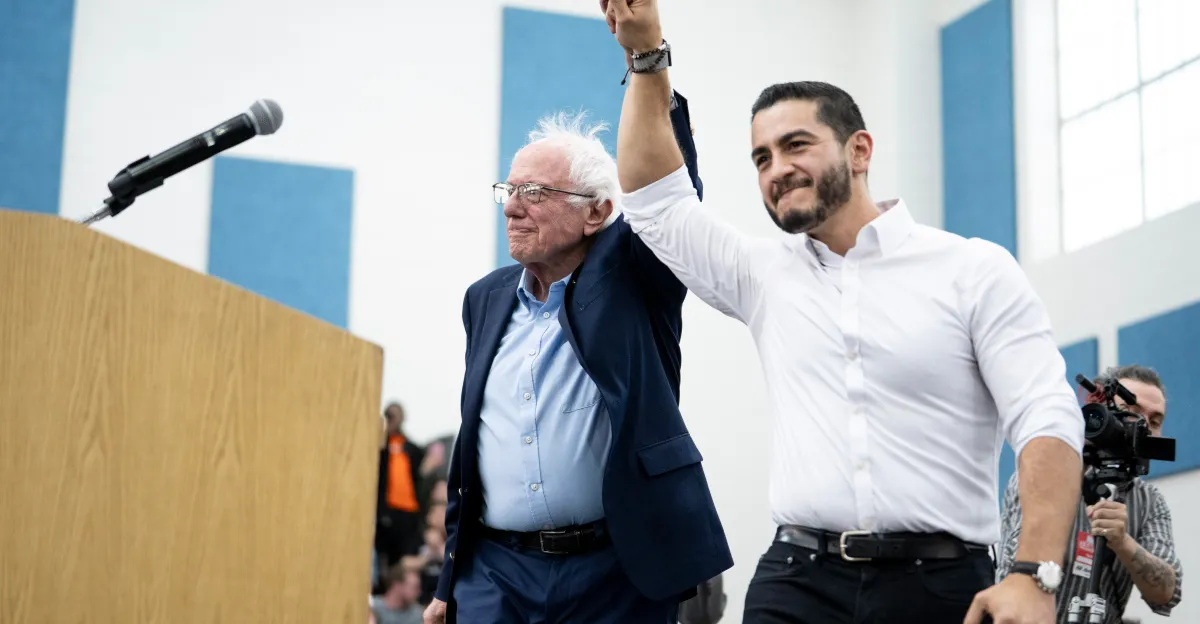
Welcome to the first edition of The Midterms, Actually. Every week I’ll be writing about two things: one thing I’m thinking about — a big idea or trend I see forming across the 2026 primaries — and one thing I’m hearing, from a voice on the ground. You can sign up here to get it in your inbox every week. Let’s get into it.
Read more The right says “suicidal empathy” is destroying the West. Here’s the truth.
One big idea
There are two ways of looking at the current divides within the Democratic Party. The first — and more dominant — narrative is that the party’s left wing is on an upward march, one that began with New York City Mayor Zohran Mamdani’s election in 2025 and has continued through this year’s Democratic primary season.
The second, and I believe more accurate, explanation is that the party is rudderless — an ideological fight to be settled in the next presidential election — and that the left’s success in New York City, Colorado, and even Maine (before Graham Platner’s campaign collapsed) grows out of a void left by a bigger, less-talked-about story: an establishment in free fall, on the wrong side of fundamental shifts across its own rank-and-file base.
The difference between those interpretations is fine, but important. I don’t think the Democratic base agrees with every position articulated by successful left-wing candidates — like “all deportations are wrong” (as NYC’s Darializa Avila Chevalier told me) — or have suddenly become committed democratic socialists. But I do think the left is on the right side of the gateway issues the base is currently prioritizing: a working-class-led affordability agenda, a skepticism of artificial intelligence, and a moral opposition to President Donald Trump’s war against Iran and to Israel’s campaigns of violence in Lebanon and Gaza. Those issues, more than any others, have defined the Democratic Party’s internal battles since 2024.
Progressives have also benefited from a moderate wing that, in many cases, has yet to lay out an affirmative vision. After the signature policies of the Biden administration flopped as political motivators, the center has seemed frozen in time, unable to offer its own blueprint for the electorate’s concerns (“abundance” aside). When I sat down with Third Way president Jon Cowan, he had no trouble assailing Hasan Piker, Abdul El-Sayed, or any number of the party’s most prominent progressive figures. But when I asked whether Third Way was actually responding to the clear shifts among the electorate — on Medicare-for-all, on abolishing ICE, on foreign aid to Israel — his answer was far less sure.
Cowan on America, Actually:
We’ve never said that there’s a problem with Hasan Piker because he advocates for Medicare-for-all. … I think Medicare-for-all is still very problematic as a political issue, and if someone were nominated for president on the Democratic ticket and they were for Medicare-for-all, I think it would be a major barrier to getting elected. But that’s not our beef with Hasan Piker at all.
It was the same evasion whenever the conversation turned from the messengers to the message. In a recent interview with US Rep. Jim Clyburn — the powerful South Carolina Democrat who has endorsed US Rep. Haley Stevens’s Senate run in Michigan — he bluntly defended insider politics, insisting party leadership was not at fault for the 2024 result. The blame, he told me, belonged to the Black voters who hadn’t turned out for Kamala Harris.
Clyburn on America, Actually:
When the white vote turned out 71 percent two years ago, and the Black vote turned out 59 percent, you tell me whose fault that is. … If that 59 percent had been 69 percent, she would’ve won.
When I asked him directly whether the argument was that Black voters had let Harris down, he didn’t hesitate: “In many instances, absolutely.” It is a remarkable thing to hear from a member of leadership — the base failed us, not the other way around — and it is exactly the instinct that has the establishment on its back foot.
This is why I think it matters to read the Democratic Party’s post-2024 convulsion as a story of establishment collapse rather than left-wing ascension. Stevens, Clyburn, and the party’s leadership would prefer to make this a referendum on the left — on the acceptability of its candidates and its media figures. But the base is communicating something else: a lack of confidence in the center, and in a version of establishment politics that prizes seniority and loyalty over voters’ values. Establishment collapse also explains the Democratic results that don’t fit neatly on the moderate vs. progressive binary: like Attorney General Phil Weiser’s victory in Colorado or whatever is happening in the Wisconsin governor’s race.
The center’s other problem is that its core general-election pitch — we may not thrill you, but we’re not Trump — is losing relevance the weaker that Trump looks politically. I spent a night at Trump’s UFC event on the White House lawn in June, an evening engineered to speak to the young men who broke his way in 2024, and found plenty of them cooling. “He was promising lower prices on everything,” one told me. “We didn’t know wars were gonna start.” Even the MAGA operative Jack Posobiec conceded that “the numbers are softer today, there’s no question about that.”
When the opposition’s own coalition is cracking, branding yourself as an inoffensive vessel who can gather up the most anti-Trump voters looks less compelling. The establishment needs an affirmative reason to be chosen — and it hasn’t found one.
So here’s my amendment to the narrative of the moment: The story isn’t a left-wing party discovering its confidence. It’s an establishment losing its own — and a base voting, in New York, in Colorado, and soon in Michigan and Wisconsin, on how much faith it still has that the center will name what it actually wants and fight for it.
What I’m hearing: A Michigan reporter’s take on the Democratic Senate race
I reached out to Samuel Robinson, a reporter for the state’s oldest Black newspaper, the Michigan Chronicle; he also has a Substack, Detroit One Million. Robinson is based on Detroit’s east side, and he’s someone I’ve known for a while, as we’re both members of the National Association of Black Journalists.
Both the Democrats’ moderate and progressive wings have invested so much in the state — it’s become the proxy war in the party’s fight over its future. What is it about Michigan that you think has made the stakes so high?
Stakes are high because of the control of Congress. But also, Michigan is like a microcosm of America. It swings back and forth every four, eight years. But our US Senate seats have been held by Democrats since 1992. Republicans say they’re going to spend a ton of money to flip the seat being opened by Gary Peters retiring. Women moderates (Dana Nessel, Gretchen Whitmer, Jocelyn Benson) won big in 2018, and eight years later, all three to some degree have disappointed their own voters. Dems had a legislative trifecta from 2022 to 2024, and many people feel like Dems let down Black residents who got them elected in the first place.
That’s one thing that unites the Black progressives and the Black establishment: Members in both camps feel the Democratic Party hasn’t done enough.
How would you describe the difference between a Haley Stevens supporter and an Abdul El-Sayed supporter?
Haley supporter — usually older; the young people I’ve met who support her typically come from wealthier backgrounds. Haley supporters are usually not involved in politics or people who keep up with national discourse. Haley supporters are worried about the gutting of the Voting Rights Act. They are worried about Trump nationalizing elections or not leaving the White House after ’28.
Abdul supporter — usually younger; the older people I’ve met who support him often acknowledge they are in the minority of their peers. The younger people who support him are all over the place in terms of their backgrounds — rich, poor, highly educated, no college. He has the support of most young people under 35. They are mostly worried about sending American taxpayer dollars to Israel, and the influence of AIPAC. I hear more about that than I do Medicare-for-all.
Stevens has sought to capitalize on El-Sayed’s perceived weakness with the Black vote. How real do you think that vulnerability is?
Abdul struggles with certain Black voters mostly because they don’t know who he is. I’ve heard from countless people who have said something to the degree of, “I don’t know enough about him.” He received media attention as the Detroit and Wayne County health director, but not enough for people to feel it. Most people know that he ran for governor in 2018 with no experience. People see Haley Stevens ads and mailers. Most Black voters aren’t on Twitter.
I saw this post on X where you were talking to a Stevens supporter who expressed some pretty bigoted claims about El-Sayed’s candidacy. How widespread is that sentiment? When I was reporting on Mamdani’s election in New York City, it was clear that there was anxiety among the Black political class that the rise of Asian, Latino, Muslim communities could displace them. Is that fear at play here?
The race is definitely a tension point between Wayne County’s Black and Muslim population. Many who have shared with me similar sentiments will point to the anti-Black racism and exploitation of our community at the hands of Arab gas station and liquor store owners. That resentment builds up and then bubbles over in a race like this. We certainly live amongst each other, like off Seven Mile on the east side, where Bengali families and Black families live side by side as next-door neighbors. But there’s a resentment that goes both ways.
The Midterms, Actually is a new weekly newsletter from Astead Herndon. Sign up here to get it in your inbox every Tuesday.
Read more Meta glasses are killing the vibe
- America, Actually
- Congress
- Midterm Elections 2026
- Politics