
This story appeared in Today, Explained, a daily newsletter that helps you understand the most compelling news and stories of the day. Subscribe here.
Read more What Democrats are still getting wrong about voters
The last US troops in Iraq formally withdrew today, 23 years after the United States first invaded Iraq and 12 years after it returned to take on the Islamic State. It’s a historic occasion, by many accounts — but also a pretty low-key one: The US has steadily scaled back its presence in Iraq for years as part of a phased drawdown inked by the Biden administration.
That drawdown represents the end of a long (and often, ugly) chapter in US military history. The US and its allies deployed tens of thousands of troops to Iraq as part of the larger war on terror that started in 2003.
Those troops left Iraq in 2011. But a smaller contingent returned three years later to stamp out the Islamic State, a violent jihadist group that had gained a major foothold after Western forces left the country.
Neither campaign was particularly popular with the American public in the end, and more than 4,500 Americans have died in Iraq in the past 20 years. Large numbers of civilian casualties, as well as drone strikes that were seen as violations of Iraq’s sovereignty, have also fueled periodic Iraqi protests against American intervention.
As the US withdraws, however, it’s leaving behind some very loose ends. Loose ends that, as we’ll see in a minute, ultimately benefit…Iran.
Go a little deeper
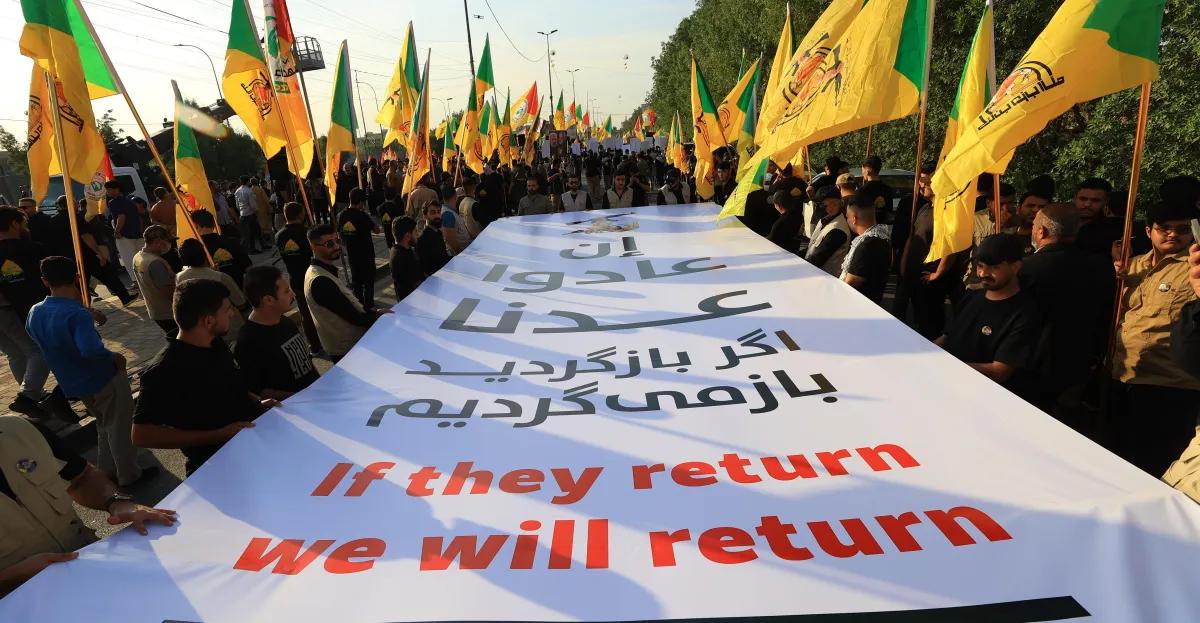
Don’t quite believe me? Just look at how Iran’s allies are celebrating today’s news. The commander of one Iranian-backed militia in Iraq called the withdrawal “a crushing defeat for the American project.”
Both Iran and the United States have spent the past 23 years attempting to shape the new Iraq. Historically, Iran and Iraq were bitter rivals — an enmity probably best demonstrated by Saddam Hussein’s 1980 invasion of Iran.
Read more The free, lightly feral hobby that will help you stop doomscrolling
After the US toppled Hussein in 2003, however, Tehran redoubled its efforts to build political and military clout in the new Iraqi state. It strengthened ties with figures like Hadi al-Amiri, whose Iran-backed Badr Organization has become a major force in Iraqi politics. It poured hundreds of millions of dollars into soft-power projects, like expanding Shiite pilgrimage sites in Iraq. And it funded, equipped, and trained a number of powerful paramilitary groups.
Some analysts have warned that the final withdrawal of US troops could embolden Iranian-linked groups in Iraq. That also seems to be a concern on the ground, where ordinary Iraqis have told reporters they fear their country “could be swallowed up” by groups linked to Iran.
Already, the Iraqi government has pushed back the deadline for Iranian-backed militia groups to disarm. It was originally supposed to happen on the official date of the US withdrawal — today.
It’s an inglorious ending, all told — and a sobering lesson on the limits of American power. The US may have the resources to handily win any military spat it gets itself into. But securing a desired political outcome is a different and more time-consuming project altogether.
It doesn’t help that US rivals like Iran seem very willing to play the long game. By dipping in and out of places like Iraq, the US may risk giving Tehran more openings.
One link for later
➨ Don’t throw out that old receipt! It — along with the political mailers, ticket stubs, business cards, product packaging, and other printed ephemera you encounter in your day — is perfectly suited to the newly viral hobby of junk journaling. It can be a powerful creative practice and the ideal antidote to doomscrolling.
Read more Trump tried to make burgers cheaper. It backfired spectacularly.
Before you go…
- Defense & Security
- Politics
- Today, Explained newsletter
- World Politics